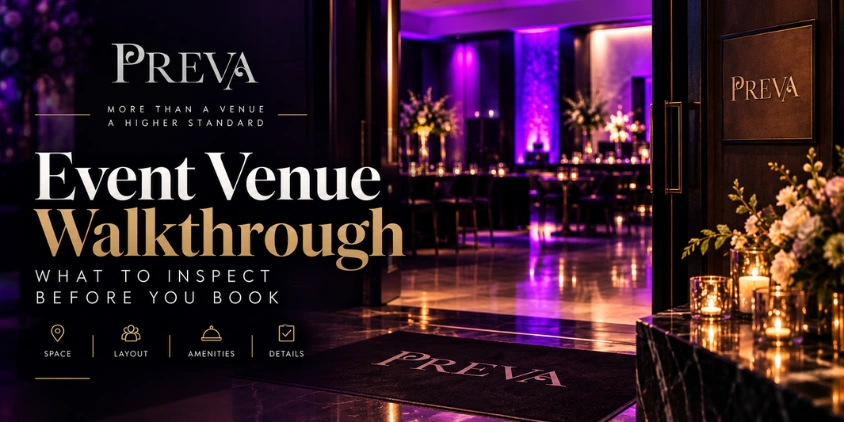
Venue photos can tell you what a space looks like.
An in-person walkthrough tells you whether the space will actually work.
When you visit an event venue, you can see how guests will enter, where they will gather, how tables may fit, whether important areas have clear sightlines, how vendors can bring equipment inside, where food and drinks may be positioned, and whether the overall layout makes sense for the event you are planning.
Those details are easy to miss when you are focused only on décor or atmosphere.
A proper Event Venue Walkthrough helps you evaluate the venue as a functioning event space—not simply as a room that looks good in photographs.
Use this guide to know what to inspect, what to physically test, and what to verify before you leave.
What Should You Check During an Event Venue Walkthrough?
During an event venue walkthrough, inspect the guest arrival route, entrance, usable event space, proposed room layout, seating, sightlines, lighting, acoustics, electrical access, food and beverage flow, restrooms, accessibility, vendor entrance, setup access, décor limitations, and the areas actually included in your event arrangement.
The most useful question to keep asking is:
How will this space function once our guests, vendors, furniture, food, and entertainment are actually inside it?
If you are still defining the event itself, understanding how to start planning an event at PREVA can help you establish your guest estimate, event type, and major requirements before evaluating a venue in detail.
Why Is an In-Person Venue Walkthrough Important?
Online galleries are useful for discovering venues.
They are not always enough for evaluating them.
Professional photographs may show a room from its strongest angle. They may have been taken when the space was empty, arranged for another type of event, or using furniture and décor that will not be present during your celebration.
A walkthrough gives you a chance to experience details that photographs cannot fully communicate.
You can ask:
- Is the entrance obvious?
- How far will guests walk from arrival to the event room?
- Does the room feel smaller or larger than expected?
- Can people move comfortably between tables?
- Is there a clear place for entertainment?
- Where will food and beverages be positioned?
- Are the restrooms convenient?
- How will vendors bring equipment inside?
- Which parts of the property are actually available for your event?
A walkthrough is therefore more than a venue tour.
It is a real-world test of whether the space supports your event plan.
Before the Walkthrough, Know What You Are Planning
You do not need a completely finished event plan before visiting a venue.
But you should know enough to evaluate whether the space is suitable.
Bring a working idea of:
- Event type
- Preferred date or date range
- Approximate guest count
- Seated or social format
- Food plans
- Beverage plans
- Entertainment requirements
- Décor ideas
- Potential vendors
- Approximate event flow
- Budget range
These details give context to the walkthrough.
A venue that works beautifully for a small cocktail gathering may not work the same way for a seated dinner, wedding reception, corporate presentation, or celebration with a DJ and dance floor.
If you are comparing venues more broadly before scheduling visits, PREVA’s guide to choosing a private party venue near Detroit covers the earlier venue-selection stage.
Once you reach the walkthrough, however, your attention should shift from choosing in theory to testing the physical space.
1. Inspect the Arrival Experience Before You Enter
Your event begins before guests step through the door.
When arriving for your walkthrough, pay attention to the experience from the street or parking area to the entrance.
Ask yourself:
- Is the venue easy to identify?
- Is the correct entrance obvious?
- Where will guests be dropped off?
- Where can rideshare vehicles stop?
- How far is the walk to the entrance?
- Is the route reasonably clear?
- What parking arrangements apply to the event?
Think about guests who have never visited the venue before.
If you needed instructions just to find the right entrance during your tour, guests may need them too.
Also avoid assuming that general parking availability means reserved spaces, complimentary parking, valet service, or a specific number of spaces for your event.
Those details should be confirmed separately.
2. Walk Through the Entrance as a Guest Would
Do not rush straight into the main event room.
Spend a moment at the entrance.
Imagine what will happen when multiple guests arrive at approximately the same time.
Where will they go?
Could the entrance become crowded?
If your event involves a guest list, check-in, tickets, wristbands, security, or another arrival process, ask where it could happen without blocking the doorway.
Also look at where guests might wait if they arrive early.
An entrance that works perfectly for two people during a tour may function very differently when dozens of guests arrive within 20 minutes.
3. Ask About Usable Capacity, Not Just Maximum Capacity
One of the easiest mistakes during an event venue walkthrough is looking at an open room and estimating for yourself how many people can fit.
Capacity depends on the setup.
A room may function very differently once you add:
- Dining tables
- Chairs
- Cocktail tables
- DJ equipment
- A stage
- A dance floor
- Food stations
- Beverage service
- A photo backdrop
- Registration tables
- Décor installations
Instead of asking only:
“What’s the maximum capacity?”
ask:
“What guest count works comfortably with the setup we’re planning?”
That answer is much more useful.
For PREVA specifically, standard restaurant reservations or VIP booking limits should not automatically be interpreted as private-event capacity. The appropriate capacity should be confirmed for the event type, layout, and date being discussed.
4. Picture the Room With Everything Inside It
An empty event room can feel much larger than it will during the actual event.
While you are standing inside the space, mentally place the major elements.
Where would guests sit?
Where would people mingle?
Where would the DJ go?
Where would food be served?
Where would speeches happen?
Where would photographs be taken?
Where might vendors temporarily store equipment?
Where would a cake, gifts, registration table, or other event feature go?
If the venue can discuss a proposed floor arrangement during the walkthrough, use that opportunity.
A simple layout conversation can reveal whether your event idea fits comfortably before you spend money designing around the space.
5. Walk the Main Guest Routes Yourself
Do not simply look around the room.
Walk through it.
Try the paths guests are likely to take:
Entrance → event area
Seating → restroom
Seating → food
Seating → bar
Event area → exit
Ask whether those movements feel natural.
Look for:
- Narrow walkways
- Awkward corners
- Doors that could become blocked
- Tables that may interrupt circulation
- Areas where food lines could develop
- Places where guests and service staff may cross constantly
Good guest flow is often invisible when it works.
When it does not work, everyone notices.
6. Test the Sightlines From Different Parts of the Room
Do not evaluate the venue only from the best position in the room.
Stand in several places.
Sit where guests might sit.
Look toward the area where the main activity would happen.
Can you see clearly?
Potential obstructions might include:
- Pillars
- Walls
- Furniture
- Screens
- Speakers
- Tall décor
- Lighting equipment
- Other guests
Sightlines matter especially if your event involves:
- Speeches
- Presentations
- Performances
- Wedding traditions
- Screens
- A stage
- Special entrances
- A head or sweetheart table
A chair fitting physically into the room does not necessarily mean it is a good seat.
7. Check the Lighting at the Right Time of Day
Lighting can change a venue dramatically.
A room viewed at noon may feel completely different at 8 PM.
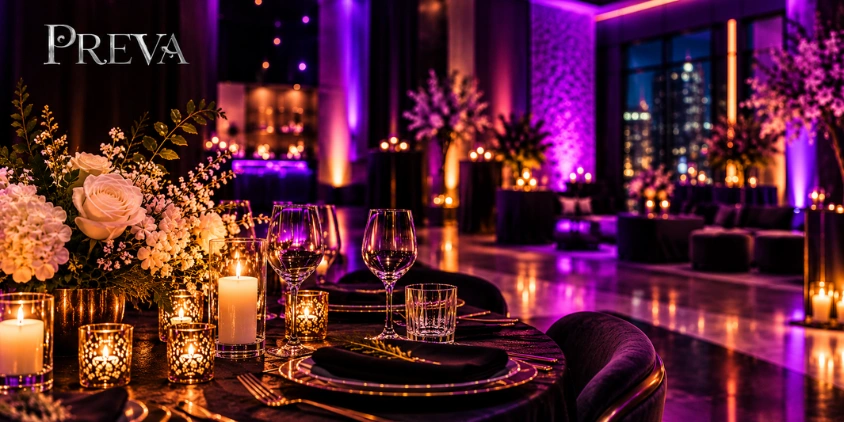
If possible, visit around the same general time your event is expected to happen.
Look at:
- Natural light
- Ambient lighting
- Main event lighting
- Dark corners
- Entrance lighting
- Lighting around food and bar areas
- Lighting near photographs or focal areas
Ask what can be adjusted.
You may also want to know whether outside lighting equipment is allowed and where it can be positioned.
If photography or video matters to your event, think about what the lighting looks like through a camera as well as to the eye.
Atmospheric lighting can look beautiful to guests but may still create challenges for photographs.
8. Listen to the Room
Acoustics cannot be evaluated from an online photograph.
During the walkthrough, stop talking for a moment and listen.
Does the room echo?
Can normal conversation be heard comfortably?
Do sounds from another part of the property carry into the event area?
Then consider what will happen once music, guests, food service, and conversations are happening simultaneously.
If you plan to have entertainment, ask about:
- DJ positioning
- Band positioning
- Speaker placement
- Sound limitations
- Sound-check access
- Outside audio equipment
- Venue-provided equipment, if applicable
Do not assume that speakers, microphones, or equipment visible during your visit are included with your event.
If the atmosphere of dinner is important to the event, you can also explore the PREVA Kitchen experience before discussing how dining may fit into your overall event flow.
9. Locate Electrical Access Before Hiring Vendors
Modern events require more electricity than many hosts realize.
Potential electrical needs can come from:
- DJs
- Bands
- Lighting
- Photo booths
- Screens
- Projectors
- Laptops
- Charging stations
- Video equipment
- Vendor equipment
During the walkthrough, look at where outlets are located in relation to where equipment would actually need to go.
Ask whether there are limitations on power usage or specific technical requirements vendors need to know.
Do not build the entire event around extension cords and hope the setup works later.
If a vendor has significant electrical needs, it is worth having them provide those requirements before the venue arrangement is finalized.
10. Inspect Where Food and Beverages Will Be Served
Food service can significantly affect guest movement.
Ask where food would be:
- Staged
- Served
- Displayed
- Cleared
Then consider where beverages will be positioned.
If the event includes a seated meal, walk the likely server routes.
If food will be placed at stations or another self-service area, think about where lines could form.
Make sure food or beverage service would not block:
- The entrance
- Restrooms
- Main walkways
- Entertainment
- Important event areas
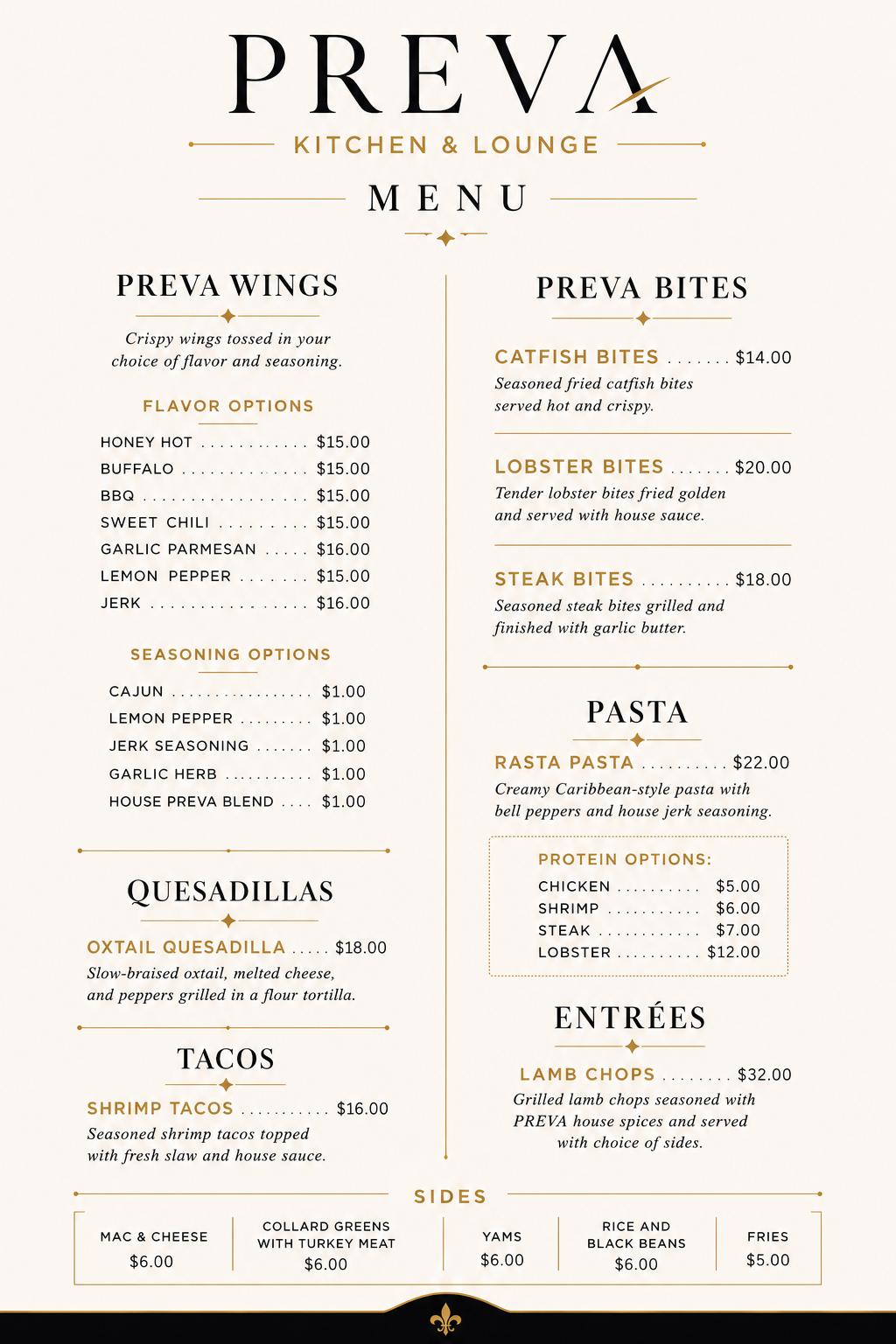
If you are considering PREVA and food is an important part of your event, browsing the current PREVA Kitchen menu can help you understand the restaurant’s regular food direction before discussing event-specific menu needs.
The restaurant menu should not automatically be interpreted as a private-event package or event-specific menu. Confirm available food arrangements, serving formats, pricing, and customization directly for your event.
11. Inspect the Restrooms
Restrooms may not be the most exciting stop during a venue walkthrough.
They still matter.
Check:
- Location
- Cleanliness
- General condition
- Ease of access
- Distance from the event space
- Accessibility
- Signage
Ask yourself whether a first-time visitor could find them easily.
Also consider whether guests will need to travel through another active area of the property to reach them.
For a longer event, you may also want to understand how restroom servicing is handled during the event.
12. Walk the Accessibility Route
Accessibility should be evaluated as a complete guest journey.
Do not simply ask whether the venue is “accessible.”
Walk the route.
Consider movement from:
Arrival → entrance → event area → seating → restroom → exit
Look for stairs, narrow passages, difficult doors, uneven routes, or other physical barriers.
If you know someone on your guest list has specific mobility or accessibility requirements, discuss those needs with the venue directly.
Do not assume photographs show everything you need to know.
13. Find the Vendor Entrance
Your guests are not the only people who need to move through the venue.
Vendors may need to carry:
- Speakers
- Lighting
- Instruments
- Flowers
- Décor
- Photography equipment
- Video equipment
- Cakes
- Rental items
Ask which entrance vendors use.
Then inspect it.
Find out:
- How far it is from vehicle access
- Whether stairs are involved
- Whether an elevator is available where relevant
- How wide the access route is
- Where equipment can temporarily be placed
- When vendor access begins
- When equipment must leave
A route that feels easy without equipment can be much harder while carrying large items.
14. Inspect Décor Possibilities Before Designing Around Them
It is easy to walk through a venue and immediately imagine decorations.
That is useful—but do not assume everything you imagine will be allowed.
Ask about restrictions involving:
- Wall attachments
- Ceiling installations
- Candles
- Balloons
- Confetti
- Large backdrops
- Specialty lighting
- Furniture movement
- Outside rentals
- Special effects
Pay attention to where décor could physically fit without interfering with guest movement or venue operations.
Event-specific décor permissions should still be confirmed directly.
15. Identify What Is Permanent and What Is Temporary
This is one of the most valuable questions you can ask:
“Will everything we’re seeing today still be here for our event?”
Some elements may belong to another event, seasonal setup, or temporary arrangement.
Clarify whether the following are permanent or temporary:
- Furniture
- Chairs
- Tables
- Lounge seating
- Lighting
- Screens
- Décor
- Audio equipment
- Staging
- Bar setup
If something you see during the tour is important to your decision, confirm whether it is included.
Do not choose a venue because of an element that may disappear before your event date.
16. Inspect the Space Through the Needs of Your Event Type
Different events require different physical priorities.
Birthday or Social Celebration
You may care most about:
- Social space
- Food
- Music
- Photography
- Guest movement
Corporate Event
You may prioritize:
- Screens
- Sightlines
- Audio
- Seating
- Presentation space
- Electrical access
Engagement Party
You might focus on:
- Conversation
- Food
- Photographs
- Comfortable social space
- Music
Wedding Reception
The venue may need to support several activities within one event:
- Guest arrival
- Dining
- Speeches
- Photography
- Entertainment
- Dancing
- Vendor movement
- Multiple transitions
If the walkthrough is specifically connected to reception planning, reviewing PREVA’s wedding information beforehand can help you arrive with more relevant wedding-specific questions.
The point is not to ask whether the venue works for events generally.
Ask whether it works for your event specifically.
17. Discuss Setup While You Are Standing in the Space
Setup questions become much easier to understand when you can physically see the room.
Ask:
- When can setup begin?
- Which entrance will setup crews use?
- Who moves existing venue furniture?
- When can decorators arrive?
- When can entertainment equipment enter?
- Where can equipment temporarily be stored?
- When must outside items be removed?
- Who handles cleanup?
Then compare those answers with what your event actually requires.
A visually simple celebration may need minimal setup.
A larger event involving entertainment, décor, lighting, photography, and multiple vendors may need substantially more time.
Understanding that while you are physically inside the venue makes planning much easier.
18. Look Beyond the Décor at General Maintenance
Do not let attractive lighting or decorations prevent you from noticing the condition of the venue itself.
Look at:
- Floors
- Walls
- Furniture
- Doors
- Fixtures
- Restrooms
- Common areas
- Guest pathways
You may notice things that professional photos do not show, such as worn furniture, damaged fixtures, visible storage, clutter, or unfinished areas.
A venue does not need to look brand new.
It should look appropriately maintained for the event experience you want to create.
If something concerns you during the walkthrough, ask about it.
19. Ask What Could Look Different on Event Day
The venue may not operate exactly the same way every day.
Ask whether your event could be affected by:
- Another event
- Different furniture
- Seasonal arrangements
- Changes in available rooms
- Temporary installations
- Different access routes
If part of the event depends on an outdoor or weather-sensitive area, physically inspect the alternative arrangement as well.
Do not simply accept:
“We’ll move inside if it rains.”
Ask to see where.
That gives you a much clearer idea of whether the backup experience still works for your guests.
20. Walk Through the Entire Event Timeline Before Leaving
Near the end of the visit, mentally run your event from start to finish.
For example:
Vendor arrival → setup → guest arrival → drinks → food → speeches → entertainment → guest departure → breakdown
Walk through the relevant spaces in roughly that order.
This simple exercise can reveal issues that individual questions do not.
You may suddenly notice that:
- Vendors cross the guest entrance.
- The food-service route intersects with entertainment.
- Guests need to cross the room constantly to reach restrooms.
- The proposed photo area blocks circulation.
- The DJ location affects sightlines.
The venue does not simply need to work while everyone is seated.
It needs to work throughout the entire event lifecycle.
What to Verify Before You Leave the Venue
Before ending the walkthrough, make sure you have physically inspected or clearly discussed the parts of the space most relevant to your event.
Verify:
- The route guests will take from arrival to the event area
- The proposed room layout
- Seating and standing areas
- Sightlines from different parts of the room
- Food and beverage placement
- Restroom location
- Accessibility routes
- Vendor entrance and load-in path
- Electrical access
- Entertainment positioning
- Setup access
- Décor possibilities
- Which areas are included in the booking
- Which furniture or equipment is permanent
- How the event would flow from beginning to end
Take notes.
If the venue permits it, take reference photos of the areas you will need to remember later.
Those photos can be especially useful when comparing two or three venues after multiple walkthroughs.
Do Not Let Atmosphere Distract You From Function
Atmosphere matters.
You should like the way the venue feels.
But atmosphere cannot fix awkward guest flow, poor sightlines, difficult vendor access, unclear setup routes, inaccessible areas, or a room configuration that does not fit the event.
Evaluate every venue from two perspectives:
How does this space feel?
and
How will this space function?
The strongest event venue should satisfy both.
Planning an Event at PREVA?
If PREVA is one of the venues you are considering, arrive at the planning conversation with a general idea of your preferred date, estimated guest count, event type, desired layout, food or menu needs, entertainment requirements, and other important priorities.
You can start discussing your event plans with PREVA once you have a clearer picture of the celebration you want to create.
During the walkthrough or planning conversation, confirm the details that apply specifically to your event rather than assuming regular dining, nightlife, VIP, wedding, or other event arrangements automatically apply.
Useful areas to inspect and discuss include the event spaces available, proposed layout, capacity for that layout, food and beverage placement, event timing, vendor access, electrical requirements, décor rules, parking arrangements, setup access, breakdown, and any items included in the event arrangement.
The more specifically you evaluate the physical space, the easier it becomes to decide whether it genuinely fits your event.
Frequently Asked Questions
1. What Is an Event Venue Walkthrough?
An event venue walkthrough is an in-person inspection of a potential event space before booking or finalizing event plans.
It gives hosts an opportunity to evaluate the physical layout, guest routes, sightlines, lighting, acoustics, restrooms, accessibility, vendor access, electrical availability, food-service areas, and other practical features that may not be clear online.
2. What Should I Bring to an Event Venue Walkthrough?
Bring your estimated guest count, preferred date, event type, basic event flow, potential vendor requirements, food ideas, entertainment needs, décor concepts, and a list of questions.
A phone or notebook can also be useful for recording measurements, observations, and details you may want to compare later.
3. Should I Visit an Event Venue Before Booking?
When practical, yes.
An in-person visit can reveal room flow, sightlines, acoustics, restroom location, accessibility, vendor routes, lighting conditions, maintenance, and other details that are difficult to understand from photographs alone.
4. How Do I Know if an Event Venue Is Big Enough?
Do not judge the venue only by looking at an empty room.
Explain your expected guest count and proposed layout, including tables, seating, entertainment, food service, dancing, or other event elements.
Then ask what number of guests works comfortably with that setup.
5. What Should I Inspect for a DJ or Live Entertainment?
Inspect where the DJ or performers could be positioned, electrical access, speaker placement, load-in routes, sightlines, sound restrictions, setup times, and how the entertainment area affects guest movement.
Also confirm what equipment, if any, is actually included.
6. Should I Inspect Parking During a Venue Walkthrough?
Yes.
Inspect or discuss where guests will arrive, park, or be dropped off and how they will reach the venue entrance.
Do not assume that general parking availability means reserved spaces, complimentary valet, or a specific amount of parking for your event.
7. What Should I Check About Food During a Venue Walkthrough?
Look at where food would be served, staged, or displayed and how guests and staff would move around those areas.
Also inspect how the food setup interacts with entrances, restrooms, seating, entertainment, and main walkways.
Event-specific menu arrangements should be discussed separately with the venue.
8. What Should I Confirm Before Leaving a Venue Walkthrough?
Before leaving, make sure you understand the guest route, proposed room layout, sightlines, vendor entrance, restroom location, food and bar placement, electrical access, setup access, and which areas are included in your event arrangement.
Physically walking these routes is often more valuable than discussing them only at a desk.
You should be able to picture how guests, vendors, staff, food, and entertainment will move through the space before deciding whether the venue works.
Inspect the Venue as a Host, Not Just as a Guest
It is easy to walk into an attractive event venue and immediately imagine the photographs.
Before you book, imagine the logistics too.
Picture guests arriving.
Walk the route they will take.
Stand where they will sit.
Look toward the main event area.
Visit the restrooms.
Find the vendor entrance.
Locate the electrical access.
Imagine food being served and entertainment beginning.
Then ask yourself:
Does the space still work?
A thoughtful Event Venue Walkthrough helps you discover those answers before they become event-day problems.
And that is ultimately what a good walkthrough should accomplish:
fewer assumptions before booking and fewer surprises when the event begins.